其實,我的這種觀點之立場很「老舊」。譬如說,讀新井一二三 <另一種專業:東京學---JR中央線之謎>(2004.12.08 中國時報 人間;當然新井一二三 等人對於popular culture的想法是對的,這也是真正日本文化能大量輸出到許多外國的主要內容。 )【hc按:這種大都市學的書,西方很平常啦,倫敦-巴黎-維也納-柏林-紐約-芝加哥…..等等不用說,加州的也洋洋灑灑……這有多難呢?其實要有點學術價值的東西,必需有許多原始資料的整理當基礎。過 去我鼓勵羅時瑋先生寫台北等,或許 Low City, High City: Tokyo From Edo to the Earthquake, 1867-1923 - E Seidensticke Middlesex, New York: Knopf, 1983 /UK: Penguin, 1985 《東京.下町.山手》是送給他的…..
譬如說,紐約時報的當地新房地產新產品 'Quality and Convenience,' at a Price (By ELEANOR CHARLES Published: December 5, 2004 )是萬樁類似事情之一端:
Homes at River Oaks on Long Ridge Road in Stamford are selling for $1.445 million to $1.56 million. "This is an extraordinarily robust upper-end boom in luxury housing with maintenance-free living that is not available in Greenwich or New Canaan," said James Fieber, head of the Fieber Group, builders of the 28-acre subdivision. "Demographically, it's a segment that will increase in viability. It's not downscaling, it's life-scaling that appeals to people from their 30's to their 70's." 】
Seidensticker的兩本書在一九八三年以及九二年問世。後來,新宿以西建設了西方高級文化之府幾所:例如,新國立劇場、TOKYO OPERA CITY、府中森藝術劇場等。然而,即使在二十年以前,恐怕大部分東京人不肯同意美國日本通的說法,因為自從二十世紀初,東京的文化前衛始終在新宿以西。 ……」
如果你是<Simon University> 的Seidensticker的忠實讀者,而且記性很好,或許知道此「美國人日本通」是日本文學的名翻譯家,尤其以川端康成作品和<源氏物語>(The Tale of Genji )馳名。
我們舉過大江先生的諾貝爾獎演講中對於川端康成標題的歧義之處理。
最近google scholar很方便,你想列舉他的作品,彈指間就完成了(希望再幾年也收入「萬國學者作品總匯」,完成全球化大業)。我 這回拜此工具之賜才知道他近年還有一本回憶錄 Tokyo Central: A Memoir (Seattle, Wash.: University of Washington Press, 2002 ) 和論「翻譯技巧」之文收入J Biguenet, R Schulte 主編的The Craft of Translation (Chicago, The University of Chicago Press, 1989); 論文Chiefly on translating the genji (The Journal of Japanese Studies)。 前google scholar前兩頁標題大要。
日本: Tokyo Rising: The City Since the Great Earthquake - E Seidensticker , Charles E. Tuttle, 1991 《東京起來》【hc:《東京新興起:1923年大地震之後再興記》】
Low City, High City: Tokyo From Edo to the Earthquake, 1867-1923 - E Seidensticke Middlesex, New York: Knopf, 1983 /UK: Penguin, 1985 《東京.下町.山手》
Japan EG Seidensticker Time-Life, 1968 這本不是台灣翻譯的『早期日本』
Tradition and Modernization in Japanese Culture -DH Shively, C Blacker - Princeton University Press, 1971
This Country Japan EG Seidensticker Kodansha, 1984 Showa: The Japan of Hirohito -C Gluck, SR Graubard Norton, 1992 ---- 日本古典文學:【Key Words
源氏物語 The tale of Genji 平安時代 Heian Period 日本文化 The culture of Japan 光源氏 Genji The Shining Prince 紫式部 Lady Murasaki Shikibu 源氏物語の概略 Summary of the tale of Genji http://mcel.pacificu.edu/as/students/genji/homepage.html 】 The Tale of Genji (Everyman's Library, No.108) Murasaki Shikibu (著), Edward G. Seidensticker (著), Murasaki Shikibu (著) The Tale of Genji (Everyman's Library, No.108)
Genji Days - E Seidensticker New York: Kodansha International, 1983 (翻譯 <源氏物語>日紀感言整理。) 【舉個例,第97頁10月7日周六 整天早上和前午都在翻譯Hotaru…..Yes, the treatment of Genji is distinctly ambiguous, ironical, one might wish to say; and there is an interesting foretaste of Niou. …(foretaste noun [S] 1. 【事】 先嚐,試食;預嚐到的滋味;預示,前兆,徵象)】
The Gossamer Years: A Diary by a Noblewoman of Heian Japan EG Seidensticker -Tuttle, 1964
---- 日本近代文學: Kafu the Scribbler: The Life and Writings of Nagai Kafu, 1879–1959 -永井荷風(他的作品大陸翻譯不少;他筆下的東京當然是翻譯者寫作的重要資料)Seidensticker - Stanford, Calif., Stanford University Press, 1965
讀本 Modern Japanese Stories: An Anthology I Morris, E Seidensticker, M Kuwata - Tuttle, 1962
三島 The decay of the angel - Y Mishima, E Seidensticker New York: Tuttle, 1973
川端康成: Thousand Cranes - Y Kawabata, E Seidensticker - Knopf, 1958 Snow Country -Y Kawabata, E Seidensticker - Cited by 1 Knopf, 1956
House of the Sleeping Beauties: And Other StoriesY Kawabata, E Seidensticker Kodansha America, 1994
Edward Seidensticker的英譯川端康成《睡美人》、《禽獸》、《一只手臂》
284 『眠れる美女』-- 睡美人 (川端康成著) full text 本;原要兼談《睡美人》、《禽獸》、《一只手臂》 1960年川端康成61歲, 是年,發表了《睡美人》(1月至翌年11月); 1968年 69歲 , 1月,《睡美人》由新藤兼人改編,拍成電影(田村高廣等主
許多話沒說,譬如說,中文翻譯在植物等,很模糊,然而 Edward Seidensticker的英譯,很科學,不會馬虎。 川端康成 的這三篇,《睡美人》、《禽獸》、《一只手臂》
,有內部關聯,雖然作品表表,從1930年代到60年代.....
----自傳和翻譯論 [BOOK] The Craft of Translation - Library Search - Web Search J Biguenet, R Schulte - Cited by 6 Chicago, The University of Chicago Press, 1989 [BOOK] Tokyo Central: A Memoir - Library Search - Web Search E Seidensticker Seattle, Wash.: University of Washington Press, 2002 Genji Days - E Seidensticker New York: Kodansha International, 1983 (翻譯 <源氏物語>日紀感言整理。)
Edward George Seidensticker (February 11, 1921 – August 26, 2007) was a noted post-World War II scholar, historian, and preeminent translator of classical and contemporary Japanese literature. His English translation of the epic The Tale of Genji, published in 1976, was especially well received critically and is counted among the preferred modern translations.[1]
Seidensticker is closely associated with the work of three major Japanese writers of the 20th century: Yasunari Kawabata, Jun'ichirō Tanizaki, and Yukio Mishima. His landmark translations of novels by Kawabata, in particular Snow County (1956) and Thousand Cranes (1958), led, in part, to Kawabata being awarded the Nobel Prize in Literature in 1968.[2]
During his years in Japan Mr. Seidensticker became friends with many of the writers he translated, though the friendships were sometimes tested during the delicate diplomatic dance that is central to the translator’s art. As Mr. Seidensticker recalled in Tokyo Central, some writers required more dancing than others:
"Tanizaki wrote clear, rational sentences," Mr. Seidensticker wrote. "I do not, certainly, wish to suggest that I disapprove of such sentences; but translating them is not very interesting. There was little I felt inclined to ask Tanizaki about."
Not so with Kawabata. "Do you not, my esteemed master, find this a rather impenetrable passage?" Mr. Seidensticker recalled asking him, ever so gently, during the translation of Snow Country.
"He would dutifully scrutinize the passage, and answer: 'Yes,' " Mr. Seidensticker wrote. "Nothing more."[12]
Seidensticker wrote widely on Japan, its people, as well as the city of Tokyo.
His first major non-translation work, "Kafu the Scribbler: The Life and Writings of Nagai Kafu, 1879–1959" (Stanford University Press, 1965), was a biography of Kafu Nagai, the Japanese writer who is noted for his sensitive depictions of the denizens of Tokyo's pleasure quarters. It was the first study to examine the life and works of Nagai to appear in any Western language. As the book includes a number of Seidensticker translations of Nagai's short stories and novellas, it is neither pure biography nor criticism. Seidensticker, to his lifelong regret, never met Kafū, even though there were opportunities to be introduced.[19]
In Low City, High City: Tokyo from Edo to the Earthquake (1983) and Tokyo Rising: The City Since the Great Earthquake (1990), Seidensticker's two-volume history of Tokyo, he weaves a tale of cultural history of how the city was impacted by the advent of Westernization, and how it responded to the twin disasters of the 20th Century—the Great Kanto earthquake of 1923 and the massive destruction incurred in World War II due to Allied bombing raids.
In his academic career, he is credited with being a teacher for his peers.
He published his autobiographical observations in Tokyo Central: A Memoir in 2001. A biography and bibliography are included in a commemorative work created by those whose lives he affected, New Leaves: Studies and Translations of Japanese Literature in Honor of Edward Seidensticker (1993).
After retirement, he divided his time between Honolulu and Tokyo, which he described as "the world's most consistently interesting city."[20]
The Nobel Prize in Literature 1968 was awarded to Yasunari Kawabata "for his narrative mastery, which with great sensibility expresses the essence of the Japanese mind"
“I am living in a world of morbid nerves, clear and cold as ice… I do not know when I will summon up the resolve to kill myself. But nature is for me more ...
川端 康成 Kawabata Yasunari, 11 June 1899 – 16 April 1972)
..,In the Oriental word for landscape, literally "mountain water," with its related implications in landscape painting and landscape gardening, there is contained the concept of the sere and wasted, and even of the sad and the threadbare. Yet in the sad, austere, autumnal qualities so valued by the tea ceremony, itself summarized in the expression "gentally respectful, cleanly quiet," there lies concealed a great richness of spirit; ......
Harold Tucker Webster was an American cartoonist known for The Timid Soul, Bridge, Life's Darkest Moments and others in his syndicated series which ran from the 1920s into the 1950s.Wikipedia
Caspar Milquetoast is a comic strip character created by H. T. Webster for his cartoon series The Timid Soul. ... is an appropriate food for someone with a weak or "nervous" stomach.
Harold Tucker Webster (September 21, 1885 – September 22, 1952) was an American cartoonist known for The Timid Soul, Bridge, Life's Darkest Moments and ...
http://neglectedbooks.com/?p=331
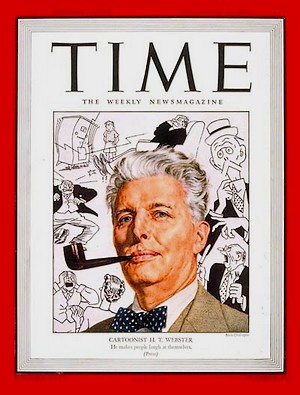
His picture made the cover of Time magazine in 1945:
Webster published over 15,000 panels over the course of 40-plus years as a newspaper cartoonist. A memorial collection of his cartoons, The Best of H. T. Webster, published in 1953, a year after his death, featured an introduction by the Pulitzer Prize-winning author, Robert E. Sherwood, and made the best seller lists. In his introduction, Sherwood wrote,
On April 4, 1953, the last new drawing by H. T. Webster was published in the New York Herald Tribune and a hundred and twenty-five other papers, and for many of us timid souls, this day marked as one of life’s darkest moments. There will be other fine artist-cartoonist-critics to inspire use with joy or indignation from day to day, but never another to span the years and the range of human emotions in the same extraordinary way that Webby did.
Webster based many of his one-panel cartoons on a number of recurring themes, and Sherwood managed to work two of them into his statement above.
“Life’s Darkest Moments” were, like many of his pieces, wonderfully succinct takes on the ways in which life consistently pokes a pin into the bubbles of our fantasies of self-importance.
Caspar Milquetoast is a comic strip character created by H. T. Webster for his cartoon series The Timid Soul. ... is an appropriate food for someone with a weak or "nervous" stomach.
Feb 27, 2017 — An aesthetic appeal to beauty and wonder, subsuming painful ethical considerations, becomes the primary rhetorical strategy with which Darwin ...
肉體快感是一種感官經驗,和純淨觀看,或純淨地感覺一顆美味水果在舌頭帶來的快感沒什麼不同,那是一種豐富無窮的經驗——讓我們認識這世界,也活在去認識世界的顯赫光輝與成熟飽滿中。對身體的官感體驗並不是壞的,而是差不多每個人都誤用它,浪費它,用它作為生命疲累的變相興奮劑,不是把它用來朝向生命最高尚峰頂而凝聚精神。人們飲食也一樣,一邊索取,另一邊浪費,把清晰需求變得暗淡,所有生命用來更新的精簡必需品也同樣變得呆板無趣。但另一種人,不是那種有依賴性的人,而至少是一個孤獨人——可以澄清自己的需要而明朗活著,他能記得動、植物的所有美麗,是來自一種耐久靜止形式的愛與欲望,他能視動物如同植物,耐心全心全意交合,繁殖,成長,不是來自肉體歡愉或痛苦,而是比任何反抗的意志來得強烈的,向大過任何苦樂的需要彎腰俯就。這個奧祕,從最細小事物開始充溢世界,假如人們能嚴肅看待,更謙虛接受,忍受,不再把困難看成是易如反掌的事。假如人們能更敬重那不論是精神或身體的生殖力,且視敬畏為唯一的條件並獲得成果。因為心智創作也是産生自生理的創作,它們共同在一個身體,讓身體有著更溫柔,更銷魂蝕骨的狂喜與歡娛。就如你説的,「僅是成為一個創造者,生殖及製造」這念頭,便缺不了在世間生活中,不斷肯定偉大事物,並朝向它而努力的行動,正是因為出自事物與動物千倍的協調——他的享受才有難以描述的美麗豐滿,因為他有來自千萬生物生產與誕生的遺傳記憶。在他的思想中,會有一千個被遺忘的情愛良夜,在每個「成為創造者念頭」的鼓舞下復活,其中注滿高貴雄偉。那些夜裡幽會,交纏著肉體快感的愛人們,是在作一種嚴肅的工作,他們收集甜蜜溫存,為將要後起的詩人儲備深沉力量,去說出那些難以言說的歡樂,他們召喚將來,即使迷失惘然,盲目擁抱,將來還是一樣來臨。每個新人類都會在這完成的基礎上成長,且在看似純粹巧合處,讓身體中的永恆法則被喚醒:一顆強壯堅定的精子猛烈衝入游移前來會合張開的卵子。但不要被這表面事物分神,注意下面深一層,一切均是律法。人們(許多人)皆如此,在誤解與失去這奧祕下渡過餘生——雖然如此,他們仍流傳下去,像一則密封的信件,即使不知道內容是什麼。不要被不同名稱和個別複雜的情況所誤導,能夠超越不同名稱和個別複雜情況的,也許是一個偉大事物:母性。而一個少女的豔麗,以及你說得好:她的「未經人事」(has not yet accomplished anything)是她害怕著、期待著、準備著的母性(Motherhood)的驚鴻一瞥。母親的美就是以母性來照顧其他人,年老婦人的身體則儲藏著豐碩的母性記憶。在我看來,男人身心也有母性,他的創造行為是一種生產,誕生就是來自裡面最奧祕的圓滿。也許男女雙方關係比我們想像更密切,也許世界大革新後,將會解放男人與女人雙方的錯誤感覺和嫌惡,不再互看雙方為異性,而是兄弟姊妹,鄰居,在一起的「人」(as human beings) ,一起忍辱負重,負擔起在他們身上棘手的性欲(sexuality)。
在里爾克的第二封信裡曾強烈推介卡卜斯去閲讀丹麥小說家雅各布森(Jens Peter Jacobsen, 1847-1855)的作品,雅各布森在哥本哈根大學主修自然學科,是個植物學及環境學專家,他深受達爾文進化論影響,分別在1871–73年把達爾文的《物種起源》(On the Origin of Species) 及1874年把《人的起源及性擇》(The Descent of Man and Selection in Relation to Sex) 譯成丹麥語,因而里爾克在信中談到性,受到達爾文學説的影響是必然的,尤其是去闡釋人類演化與性擇演化的作用。性擇基本上是獨立存在、由物種自行引導過程(主要是由雌性個體推動)。達爾文說,雌性個體具有「美的品味」(taste for the beautiful),以及「美學技能」(aesthetic faculty),雄性則需要盡力「吸引」配偶,所以里爾克才會說:「一個孤獨人——可以澄清自己的需要而明朗活著,他能記得動、植物的所有美麗,是來自一種耐久靜止形式的愛與欲望,他能視動物如同植物,耐心全心全意交合,繁殖,成長,不是來自肉體歡愉或痛苦,而是比任何反抗的意志來得強烈的,向大過任何苦樂的需要彎腰俯就。」但是也因這樣受到達爾文物種遺傳的影響,里爾克太過強調性愛與物種適存(fitness of species)需要,才會説:「假如人們能更敬重那不論是精神或身體的生殖力,且視敬畏為唯一的條件並獲得成果。因為心智創作也是産生自生理的創作,它們共同在一個身體,讓身體有著更溫柔,更銷魂蝕骨的狂喜與歡娛。就如你説的『僅是成為一個創造者,生殖及製造』這念頭,便缺不了在世間生活中,不斷肯定偉大事物,並朝向它而努力的行動,正是因為出自事物與動物千倍的協調——他的享受才有難以描述的美麗豐滿,因為他有來自千萬生物生產與誕生的遺傳記憶。」這種傾向達爾文對人類萬億年來的適者性擇遺傳演變,與宗教以「創造者」身分解説宇宙萬物產生背道而馳,更何況里爾克是一個虔誠基督徒!所以後來在第六封信,便對基督下凡降生有很美好的申述。


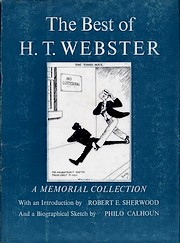 Webster published over 15,000 panels over the course of 40-plus years as a newspaper cartoonist. A memorial collection of his cartoons,