2016年8月16日 星期二

翻譯觀摩:董橋的 Gabriel Garcia Marquez Meets Ernest Hemingway


今天看到The Paris Review的新聞之一:
Hunter S. Thompson’s widow returns Ernest Hemingway‘s antlers
覺得還是Gabriel Garcia Marquez 寫在巴黎遇見其英雄暮年海明威的自敘好得多,而董橋的譯筆和轉述多好!
收入董橋 《小風景》香港:牛津大學出版社,2003,頁156-59

Gabriel Garcia Marquez Meets Ernest Hemingway, July 26, 1981;董橋:反戰思維裏的星火2003.2.12


http://hcbooks.blogspot.tw/2016/08/gabriel-garcia-marquez-meets-ernest.html

2016年8月14日 星期日

錢鍾書先生翻譯舉隅--摘自《圍城》the naked truth 、《談藝錄》

這是從網路找到並改成正體字 (原文未交代版本 許台灣書林版不同)
原文頁數都用 P 應該改成 " p."/ 我並將原文書名以斜體
讀者最好參看原書的上下文 否則不易了解其深意


錢鍾書先生翻譯舉隅--摘自《談藝錄》
錢鍾書先生當代碩學,其博學多聞,覃思妙慮,並世罕儔。世人咸知先生通多國文字​​,顧先生少有譯作,唯於著述中援引外國作家之語類多附註原文,學者於此得所取則。唯零金碎玉檢索不易,爰特蒐集成冊,以便觀覽。後生末學得窺雲中之一鱗,證月印於千江,則此帙之輯為不虛矣。
——李慎之一九八九年六月

原文page 都用P.
我用p. 不過改不勝改

1. If all the sky were parchment and all the sea were ink按“青天做紙張”之語,西方各國詩人皆有之,常以“碧海化墨水”為對。 P.19
2. New forms are simply canonization of inferior genres.百凡新體,只是向來卑不足道之體忽然列品入流。 P.35
3. behind its attributes須在未具性德以前,推其本質。 P.37
4. “Not of the letter, but of the spirit; for the letter killeth, but the spirit giveth life.”意在言外,得​​意忘言,不以詞害意。 P.43
5. To hold, as’t were, the mirror up to nature.持鏡照自然。 P.60
6. selective imitation取捨之工。 P.60
7. This is an art / Which does mend nature, change it rather, but/ That art itself is Nature (The Winter's Tale, IV, iv. Polixenes)莎士比亞嘗曰​​:“人藝足補天工,然而人藝即天工也。”p.61
8. In shape the perfection of the berry, in light the radiance of the dewdrop. (Lord Tennyson; A Memoir, by his son, Vol. I, P.211)體完如櫻桃,光燦若露珠。 P.114
9. “A poem round and perfect as a star. ”(Alexander Smith: A Life Drama)“詩好比星圓。”P.114
10. “It used to be said of a famous cricketeer that he bowled or batted with his head. ”(S. Alexander: Beauty and Other Forms of Value, p.25)畫以心而不以手。 P.211
11. A direct sensuous apprehension of thought.能以官感領會義理。 P.232
12. Be thou thine own home, and in thy selfe dwell;/Inn any where, continuance maketh hell./ And seeing the snaile, which every where doth rome, /Carrying his owne house still, still is at home.(Complete Poetry and Selected Prose, ed. J. Hayward, pp.153-4)萬物皆備於身,方之蝸牛戴殼,隨遇自足,著處為家。 —— 約翰唐(John Donne)名篇: (To Sir Henry Wotton)P.232
13. “Poetry should strike the Reader as a working of his own highest thoughts and appear almost a Remembrance. ”(Letter to Taytor, 27 Feb. 1818, HE Rollins, ed., Letters I, 238)“好詩當道人心中事,一若憶舊而得者。” ——濟慈(Keats) 論詩第一要義(axiom)P.255
14. ear pleasure悅耳 P.269
15. mind pleasure饜心 P.269
16. unreasonable or magical element不落理路、神幻無方。 P.269
17. natural magic魔力 P.269
18. inspiration落筆神來之際 P.269
19. catharsis情慾宣洩 P.270
20. purification齋心潔己 P.270
21. All Arts aspire to the condition of music.佩特謂諸藝造妙皆嚮往於音樂之空靈澹盪。 P.271
22. Most imitative of arts(SH Butcher: Aristotle's Theory of Poetry and Fine Art, P.122)“樂在諸藝中最近自然。”P.271
23. committed fornication意淫 P.273
24. mental fictions亂真 P.273
25. “All emotion, Of thorough enough, would take one to heaven.”“一切情感,充極至盡,皆可引人入天。” p.288
26. “This creative reason thinks eternally. Of this unceasing work of thought, however, we retain no memory, because this reason is unaffected by its objects. ”(Aristotle's Psychology, with Introduction and Notes, by E. Wallace, ” p.161, p.272)“無時間性,變易不居,勿滯於物,不可記憶。” P.289
27. “None can care for literature in itself who do not take a special pleasure in the sound of names. ”“凡不知人名地名聲音之諧美者,不足以言文。”——史梯芬生《遊美雜記》(Stevenson: Across the Plains Tuesday) P.295
28. “Silence and speech acting together”“語言與靜默協力”——卡萊爾論象徵P.309
29. “Leave something to the willing intelligence of the reader. ”須留與讀者思量。 ——佩特論文 P.309
30. thinking intently of his own name英詩人丁尼生常言自思其名字,繫念不散。 P.312
31. “and the earth looked black behind them, /as though turned up by plows. But it was gold,/All gold—​​a wonder of the artist's craft. ”—Iliad, XVIII 630-32“犁田發土,泥色儼如黑。然此盾固純金鑄也,蓋藝妙入神矣。”p.318
32. “O! One glimpse of the human face, and shake of the human hand, is better than whole reams of this cold, thin correspondence, etc. ”—Works, ed. EV Lucas, VI, 175“得與其人一瞥面、一握手,勝於此等枯寒筆墨百函千牘也。噫!” p.320
33. habitualization, automatization落套刻板 P.320
34. defamiliarization使熟者生 p.320
35. rebarbarization使文者野 p.320
36. “Grace of style comes from arrangement. ”“詞意位置得當,文章遂饒姿致。”p.325
37. repose, perfect fitness一字之穩當 p.328
38. “I have such a sensitive ear that the repetition of a word irritates me three pages away. ”—A. Rhodes, The Poet as Superman, 46“至謂一字在三頁後重出,便刺渠耳。”—— 鄧南遮 p.329
39. “We have had the brow and the eye of the moon before; but what have we reserved for human beings, if their features and organs are to be lavished on objects without feeling and intelligence? ”—Letters: Later Years, ed. E. de Selincourt, I, 436“語已有月眉、月眼矣。复欲以五官百體盡予此等無知無情之物,吾人獨不為己身地耶。”—— 華茲華斯 p. 344
40. “The first is physical. The second is intellectual and is much higher. The third signifies a nobler power of the soul which is so high and so noble that it apprehends God in His own naked being. ”—Sermon XIX, in James M. Clark, Meister Eckhart, 220, cf. 62“學為有上中下三等:下學以身;中學以心知;上學以神,絕倫造極,對越上帝。” ——十四世紀德國神秘宗師愛克哈特(Meister Eckhart)p. 366

"對越",看不懂。

《圍城》開頭就用漢字說:真理是赤裸裸的。通常的人都搞不懂它的意思。
 這是the naked truth 的"翻譯"
不過,此處的Naked,意思不是"裸體的",而是"公開的、不掩飾的":
(Especially of feelings or behaviour) expressed openly; undisguised:


41. Meister Eckhart, Sermon, XII:“I take a basin full of water, place in it a mirror and put it below the sun's disc. The reflection of the sun is the sun within the sun, and yet the mirror remains what it is. “以一鏡照形,以餘鏡照影,鏡鏡相照,影影相傳;是形也、與影無殊,是影也、與形無異。”P.371
42. “If Galileo had said in verse that the world moved, the Inquisition might have left him alone. —quoted in R. Gittings, The Older Hardy, Penguin, 1980, 120“苟伽俐略只作詩述其地球轉動說,則宗教法庭或且任縱之而不問。”——哈代P.388
43. To count chicken before they are hatched.“卵未抱而早計雛數。”p. 392
44. Edward Young, Conjectures on Original Composition: “A genius differs from a good understanding, as a magician from an architect; that raises his structure by means invisible, this by the skilful use of common tools.”—ED Jones, ed., English Critical Essays;16th, 17th and 18th Centuries, “The World's Classics”, 279“天才與聰慧之別,猶神通之幻師迥異乎構建之巧匠;一則不見施為,而樓台忽現,一則善用板築常器,經之營之。”——愛德華·楊P .411
45. EH Gombrich, Art and Illusion, 5th ed., 1977, 174-5,“screen”, “the power of expressing through absence of brush and ink.”無筆墨處與點染處互相發揮烘托。 P.415
46. “The most beautiful figure is the sphere among solids and the circle among plane figures.”—Diogenes Laertes, VIII. 35, “Loeb”, II, 351立體中最美者為球,平面中最美者為圈。 ——畢達哥拉斯 P.430
47. “Let it (the mind) once become a sphere, and spherical it abides.”—Marcus Aurelius, Meditations VIII§41, tr. J. Jackson, 152心不為外物所著,當如圓球。 ——古羅馬哲人馬可·奧勒留 P.430
48. “On a Drop of Dew”So the Soul, that Drop, that Ray,Of the clear Fountain of Eternal Day,Does, in its pure and circling thoughts expressThe greater Heaven in an Heaven less—Helen Gardner, ed., The Metaphysical Poets, Penguin, 1972, 241露珠圓澄,能映白日,正如靈魂之圓轉環行,顯示天運也。 ——英國詩人馬委爾(Andrew Marvell)《露珠》詩P.431
49. “Till rolling time is lost in round eternity.”—Dryden, The Hind and Panther, Pt III, 1.19圓永恆 P.431
50. Why, ​​at the height of desire and human pleasure—worldly, social, amorous, ambitious, or even avaricious—does there mingle a certain sense of doubt and sorrow?—LA Marchand, Byron, 1957, II, 900入世務俗,交遊酬應,男女愛悅,圖營勢位,乃至貪婪財貨,人生百為,於興最高、人最歡時,輒微覺樂趣中雜以疑慮與憂傷,其故何耶P.438
51. I have thought some of nature's journeymen had m​​ade men, and not made them well, they imitated humanity so abominably.— Hamlet, III. Ii“其人似為大自然之學徒所造,手藝甚拙,像人之形而獰惡可憎。”——哈姆雷特P.464 (?)
52. One may remember the lion of medieval bestiaries who, at every step forward, wiped out his footprints with his tail, in order to elude his pursuers.—L. Spitzer:“Linguistics and Literary History”, in DC Freeman, ed., Linguistics and Literary Style, 1970, 31有如中世紀相傳,獅子每行一步,輒掉尾掃去沙土中足印,俾追者無可踪跡。 P.466
53. Why does a painting seem better in a mirror than outside it? —Leonardo da Vinci, Notebooks, tr. E. Maecurdy, II, 272“鏡中所映畫圖,似較鏡外所見為佳,何以故?”P.483
54. Of making many books there is no end; and much study is a weariness of flesh. —Ecclesiastes, xii. 12“書籍無窮,多讀徒疲精弊體。”——舊約全書P. 502
55. Wit, you know is the unexpected copulation of ideas, the discovery of some occult relation between images in appearance remote from each other.—Rambler, No. 194, Everyman's Lib., 284;cf. R. Wellek, A History of Modern Criticism , I, 3“使觀念之配偶出人意表,於貌若漠不相關之物象察見其靈犀暗通。”——約翰生P.522
56. Foregrounding, the intentional violation of the norm of the standard, distortion刻意破常示異。 P.532
57. Normally every datum of sense is at once devoured by a hungry intellect and digested for the sake of its vital juices. Knowledge is not eating. —G. Santayana, The Life of Reason, I, 75, 77當世論師以唯心論與為實論均常擬致知於飲食,遂嘲為“口腹哲學。” P.535
58. Everything is the same, but you are not here, and I still am. In separation the one who goes away suffers less than the one who stays behind. —Leslie A. Marchand, Byron, II 783“此間百凡如故,我仍留而君已去耳。行行生別離,去者不如留者神傷之甚也。”P.541
59. Poetry, like schoolboys, by too frequent and severe corrections, may be cowed into Dullness.—The Notebooks of ST Coleridge, ed. K. Coburn, I 35詩苟多改痛改,猶學童常遭塾師撲責,積威之下,易成鈍兒。 ——柯爾律治 P.557
60. that particular kind of borrowing which thinks to disguise itself by inserting or extracting “notes”—G. Saintsbury, History of Criticism, III, 591“取古人成說,是其所非,非其所是,顛倒衣裳,改換頭面,乃假借之一法耳。”P.562
61. They are to me original: I have never seen the notions in any other place; yet be that reads them here persuades himself that he has always felt them. —Lives of the Poets, ed., B. Hill, III, 442“創闢嶄新,未見有人道過,然讀之只覺心中向來宿有此意。”——葛雷(Thomas Gray)憑弔墟墓詩P.573
62. Now I never wrote a “good” line, in my life, but the moment after it was written it seemed a hundred years old. Very commonly I had a sudden conviction that I had seen it somewhere.—OW Holmes, The Autocrat of the Breakfast Table, ii“吾生平每得一佳句,乍書於紙,忽覺其為百年陳語,確信曾在不憶何處見過。”——霍姆士P.574
63. History is philosophy teaching by or learned from examples.“歷史乃哲學用以教人之實例。”P.586
64. Use of the description instead of the name of a thing—Rhetoric, VI. i, Loeb, 375不道事物之名而寫事物之狀 P.567
65. in peace—which is as much above joy as joy is above pleasure, and which can scarcely be called emotion, since it rests, as it were, in final good, the premium mobile, which is without motion—we find ourselves in the region of “great art”—C. Patmore,Principle in Art 1889, 29藝之至者,終和且平,使人情慾止息,造寧靜之境;此境高於悅愉,猶悅愉高於痛快也。 P.589
66. I never can catch myself.自我不可把捉。 ——休謨 P.597
67. The passage is remarkably like a central tenet of Buddhism, a cult of which Hume could hardly have heard.—O. Elton, A Survey of English Literature: 1730—1780, 1928, II, 163酷似佛教主旨,然休謨未必聞有釋氏也。 P.597
68. Shakespeare in composing had no I, but the I representative. —Biographia Literaria, ed. J. Shawcross, I, 213 note無我而有綜蓋之我。 ——柯爾律治 P.597
69. When I am assailed with heavy tribulations, I rush out among my pigs, rather than remain alone by myself. The human heart is like a millstone in a mill: when you put wheat under it, it turns and grinds and bruises the wheat to flour ; if you put no wheat, it still grinds on, but then' tis itself it grinds and wears away. So the human heart, unless it be occupied with some employment, leaves space for the devil, who wriggles himself in, and brings with him a whole host of evil thoughts, temptations and tribulations, which grind our the heart. — Martin Luther, Table Talk, tr. W. Hazlitt, “Bohn's Library”, 275“吾遭逢大不如意事,急往飼牧吾豬,不欲閒居獨處。人心猶磨坊石磑,苟中實以麥,則碾而成面;中虛無物,石仍轆轉無已,徒自研損耳。人心倘無專務,魔鬼乘虛潛入,挾惡念邪思及諸煩惱以俱來,此心遂為所耗蝕矣。”——馬丁·路德P.599
70. Peer Gynt, IV. Xiii, Begriffenfeldt:“Long live the Emperor of self; V. v, Peer:“There's a surprising lot of layers (in the wild onion).Are we never coming to the kernel?There isn’t one!To the innermost bitIt's nothing but layers, smaller and smaller…”Everyman’s Library 171, 201-2易卜生一名劇中主角號:“自我之皇帝”而欲覓處世應物之“自我”,則猶剝玉蔥求其核心然,層層揭淨,至境無可得。 P.600
71. For one can only“interpret”a poem by reducing it to an allegory—Which is like eating an apple for its pips.—G. Orwell, Collected Essays, Journalism and Letters, 1968, I, 72“此舉何異食蘋婆者,不嗜其果脯而咀嚼其果中核乎。”P.610
72. The movement of love is circular, at one and the same impulse projecting creatures into independency and drawing them into harmony.—Collected Papers, ed. C. Hartshorne and P. Weiss, VI, 191情愛運行,做團圓相,此機一動,獨立與偶合遂同時並作,相反相成。 ——美國哲學家皮爾斯 P.615

2016年8月13日 星期六

難以中譯例:『《異鄉人》開頭的第一句』等等Chiaheng Wu; 日语敬语含蓄悠长的意蕴


《異鄉人》開頭的第一句,有很強的存在感:「今天,媽媽死了。」( Aujourd’hui, maman est morte.)這句話用的是現在式,很清楚地表達了這件事發生的時間點:在敘述者說這句話的那一天。
這句話陳述了一個事實,一個不會改變的事實。但稍微仔細推敲,其實不應該用「今天」。因為,這本小說是用第一人稱來敘述,而我們知道(主角也知道),他在母親去世之後殺了人,受審,被判處死刑。所以,真實的敘述時間,應該在他被判刑後、行刑前,那個敘述時間點的「今天」,絕對不是主角母親去世的那一天。但是,在這本小說的第一句,劈頭就說:「今天,媽媽死了。」讀者毫無防備,很容易就接受了這個「今天」,被敘述者帶到他母親去世的那一天,一起感受這個突如其來的消息所帶來的震撼。
做為讀者,我們為什麼那麼輕易就接受了這個「今天」?在這方面,卡謬做了一些安排,用「過去」與「未來」來鞏固「今天」這個「現在」。
在《異鄉人》的頭兩段,出現了三種時態。媽媽的去世用的是現在式,以此為基準畫一條線,在「現在」這條線之前,是過去,用了「複合過去式」(LE PASSÉ COMPOSÉ)來表達已經發生的事情:「我收到了從養老院發來的電報」(J’ai reçu un télégramme de l’asile)、「我跟老闆請了兩天假」(J’ai demandé deux jours de congé à mon patron)。在「現在」這條線的另一邊,則是還沒發生的「未來」,也代表了主角的一番盤算:「我會搭兩點的巴士」(Je prendrai l’autobus à deux heures)、「我會在下午抵達(養老院)」(J’arriverai dans l’après-midi)、「我可以守靈」(Je pourrai veiller)、「我會在明晚回來」(Je rentrerai demain soir)。連續四個句子都用未來式,表示這幾件事還沒發生。
過去與未來,就像圍繞在現在周圍的陰影,能把現在襯托得更加真實可信。從《異鄉人》的頭兩段,我們幾乎可以清楚定位寫下這段文字的時間:主角收到電報,向老闆請假獲准,然後,或許他抽了根菸,心裡開始想這件事,以及如何安排這兩天的喪假,「今天……」。主角的心情完全是在工作模式下,口吻完全不帶一絲感情,反而像是出差去處理某件事。的確,在兩段出現了兩個人物,一個是已經去世的母親,一個就是他的老闆,這使得他在面對母喪這件事的第一個反應(至少是透露給讀者的心情)不是悲傷,而像是在處理一件公事。相較之下,養老院的電報,雖然簡潔,但是面面俱到,「母喪,明日下葬,」然後是Sentiments distingués。就這麼三句話。
電報不同於現在的line或email,以字算錢,自然是毫無廢話。第一句說明事實,第二句說明處理的方式與時間,第三句,人死了,總要說點場面話,表達對此事的哀悼之意。但是反觀主角,似乎完全看不出他有任何Sentiments distingués,強烈的情緒。反而,他的反應極為冷淡,看不出他有任何波動。這到小說最後,成為主角被定罪的強力理由:他用冷血手法殺了一個阿拉伯人,更重要的是,他對於母親去世的無動於衷,而且不信上帝,在在說明了此人的罪惡深重。
然而,人對於母親、對於上帝的愛,對於所有事情的反應,都不是只有一種方式,好像不用某種特定的方式,就是不愛母親、不愛上帝。
《異鄉人》的主角,對母親是有自己一套深刻的情感,而母親去世對他是有極大震撼的。這個震撼就表現在劈頭的那一句:「今天,媽媽死了。」世界上只有兩種人,有媽的,還有媽媽不在的。在第一句,主角並不是用母親(Mère)這個字,而是用媽媽(maman),說明了他與母親的親暱。母親一旦去世,人與這個世界的關係,就此徹底改變,世界跟這個人的最重要的聯繫,就此斷裂。在《異鄉人》中,可以說母親的去世,最後也導致了主角與世界的斷裂(死亡)。這種斷裂的震驚,從第一句就可以感受到。這個消息,就算心裡有所準備,還是造成很大的衝擊,也造成了一種錯覺,好像母親是在他接到電報的那一刻去世的。
當然,母親在他接到電報之前的某一刻,已經去世了,但是對主角來說,這個事實還不存在,直到他接到電報的那一刻。事物是否在客觀上存在,並不是該事物存在的要件,其存在被感知了,對那認知的主體來說,才能說它是存在的。這種由主觀認知來判定存在與否,在這兩段可以清楚看到。對於主角來說,母親的去世,這個事實是在收到電報的那一刻存在的。對於主角的老闆來說,他連「節哀順變」之類的話都沒說,他要等到看到主角戴孝,他的母親去世的事實才算成立。
《異鄉人》的時間感與卡謬要表達的存在感,有很深的關聯。但是中文本身是一種時間感並不明確的語言,並不是從動詞的樣態就表現出時態。中文的模糊靈活有它的優點,但是放在像《異鄉人》這樣的小說,翻成中文時,作者的一些安排布置的線索,或許就容易忽略了。
Lu par Michael Lonsdale. ------------------ L'Étranger est un roman d'Albert Camus, paru en 1942. Il prend place dans la tétralogie que Camus…
YOUTUBE.COM


~~~~~

http://www.thepaper.cn/newsDetail_forward_1510503
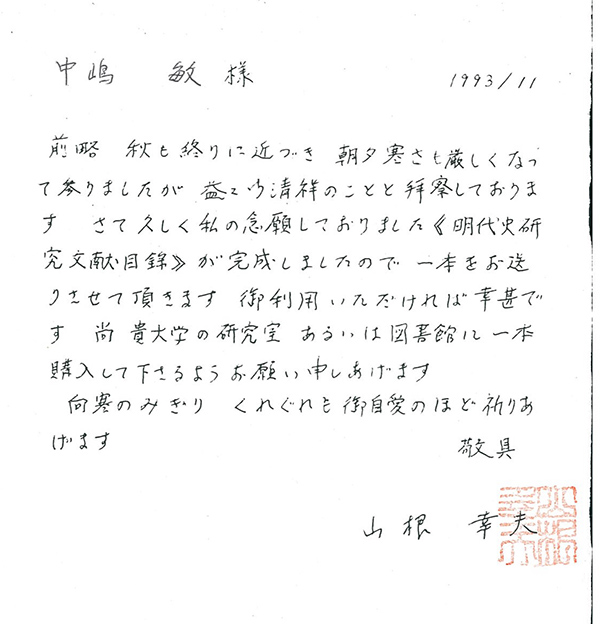
买《新编明代史研究文献目录》时一开始没有标价格,我只好把书拿到收银台询问,老板看了一眼书后,回答道:“2000日元”,然后慢慢抬起头,微笑着对我说:“这本可是山根先生送给中嶋先生的哦,你懂的吧?”
我笑着点头,两位都是东洋史学家、也是1963年成立的“古典研究会”第一批会员。山根幸夫专攻明史和中日关系史,著作极多,难以列举。中嶋敏1910年出身于静冈县,1933年凭论文《北宋年间西夏与吐蕃之关系研究》毕业于东大,专攻宋史和中国经济史。他先任职东方文化学院研究所,加入由经济史学家加藤繁(1880-1946)主持,聚集了中山八郎、佐久间重男、西嶋定生等青年才俊的“历代正史食货志研究会”,在翻译《汉书·食货志》的同时,渐得实证史学之蹊径。
正史食货志的翻译,除了中译日外,还得对诸如“子粒”、“盐引”、“折色”等疑难词,做详细的注解,故工程量浩大,非一人之力可就。在几代人的接力中,加藤繁完成了《汉书》、《旧唐书》、《旧五代史》部分,和田清完成《明史》(上、下)和《宋史》(一)部分。两人过世后,中嶋敏陆续将《宋史》的(二)到(六)和《晋书》补齐,另有文集《东洋史学论集》问世。山根、中嶋两人,既是东大校友,又是同行,来往想必不少。所以这本目录除了山根的题签以外,还夹了一张小巧的信笺,上面写道:
中嶋敏 様:             1993/11
前略。秋も終わりに近づき、朝夕寒さも厳しく存って参りましたが、益々な清祥のことと拝察しております。さて久しく念願しておりました《明代史研究文献目録》が完成しましたので、一本をお送りさせて頂きます。御利用いただければ幸甚です。尚貴大学の研究室あるいは図書館に一本購入して下さるようお願いもうしあげます。
向寒のみぎり、くれぐれも御自愛のほど祈りあげます。
敬具

山根幸夫
日语敬语含蓄悠长的意蕴,难以用中文精准表达,兹录其原文如上。此信的大意,是山根以天气为话头寒暄之后,再介绍自己费时多年编好这本目录,特意赠中嶋一本,同时希望他能推荐自己所在的大学和研究室采购此书。写此信时山根已经72岁,停年退官三年多,但退而不休,仍然担任中国明史学会荣誉顾问、东京大学中国学会会长、明治大学讲师等职,不但笔耕不辍,还多次赴中国敦煌、乌鲁木齐、西安等地开会及考察。