海明威1964年身後出版的A Moveable Feast
A Moveable Feast is a 1964 memoir by American author Ernest Hemingway about his years as a struggling expat journalist and writer in Paris during the 1920s.
這本書70年代即有中譚知敬的譯本,台北:晨鐘,向日葵譯叢。
當時為免讀者搞不清楚,書名取為第3章章名:失落的一代
有道:可愛的不可信.....
時報出版
【讀報。讀書】
美國大作家海明威記述一九二○年代旅居巴黎生活的回憶錄「流動的饗宴」(A Moveable Feast),在巴黎遭受恐攻後,成為民眾團結的象徵,躍居暢銷書排行榜榜首。
在哀悼恐攻罹難者的場合,常見人手一本「流動的饗宴」,擺在鮮花和蠟燭間。傷亡最慘重的巴塔克蘭劇院,門前也放了好幾本。 ⋯⋯更多
海明威回憶錄 巴黎人的心靈救贖| 聯合新聞網
海明威巴黎回憶錄「流動的饗宴」,頻頻出現在追悼恐攻罹難者的場合
UDN.COM|由聯合新聞網上傳
「如果你夠幸運,在年輕時待過巴黎,那麼巴黎將永遠跟著你,因為巴黎是一席流動的饗宴。」海明威寫下這段話。
“If you are lucky enough to have lived in Paris as a young man, then wherever you go for the rest of your life, it stays with you, for Paris is a moveable feast.”
― Ernest Hemingway, A Moveable Feast
― Ernest Hemingway, A Moveable Feast
movable feast 比較常見
2008 妙子曰:「"牌子上刻著海明威在《流動的饗宴 ???》中的一句話:「這就是我們年輕時的巴黎;雖然窮,卻很快樂。」......晚年的海明威曾說:「要是我那時候死了就好了。」唉!"」
hc
昔日即指出,台灣版翻譯此"書名"雙關語時,望穿秋水,未提其玄機。
movable feast為基本曆法知識:"年によって日の異なる祝祭日 ((Easterなど))".
movable feasts :可移動慶節;非固定慶節:日期每年變換、不固定的慶節(瞻禮),如復活節、耶穌升天、聖神降臨、天主聖三等。
如硬要這樣說, 或許可考慮"巴黎的變易時空的不散筵席"....
一個法國在地的朋友來信提到一個因謠言而偶發的虛驚事件,當他走在大馬路上,人們突然在街上狂奔,夾雜著婦女的尖叫和哭泣,他被擠到角落,附近的住家則迅速熄燈,拉上窗簾……。我想這樣的陰影,還會持續一陣子。有一個造訪巴黎時認識的朋友,寫信向他問候,還沒有得到回信,希望那個週五晚上,他沒有外出看戲,他是個編劇。
海明威曾說巴黎是一席流動的饗宴,對我來說,這流動,永不止息。
movement
在凌淑華(Su Hua)1953的古韻 (Ancient Melodies)翻譯本(台北1991 北京1994/2003)中有"太平天國運動"說法
應該是錯誤的
又日本的賞櫻時節四似非"櫻花節"
-----
Letter from Our Paris Editor
December 2, 2015 | by Antonin Baudry
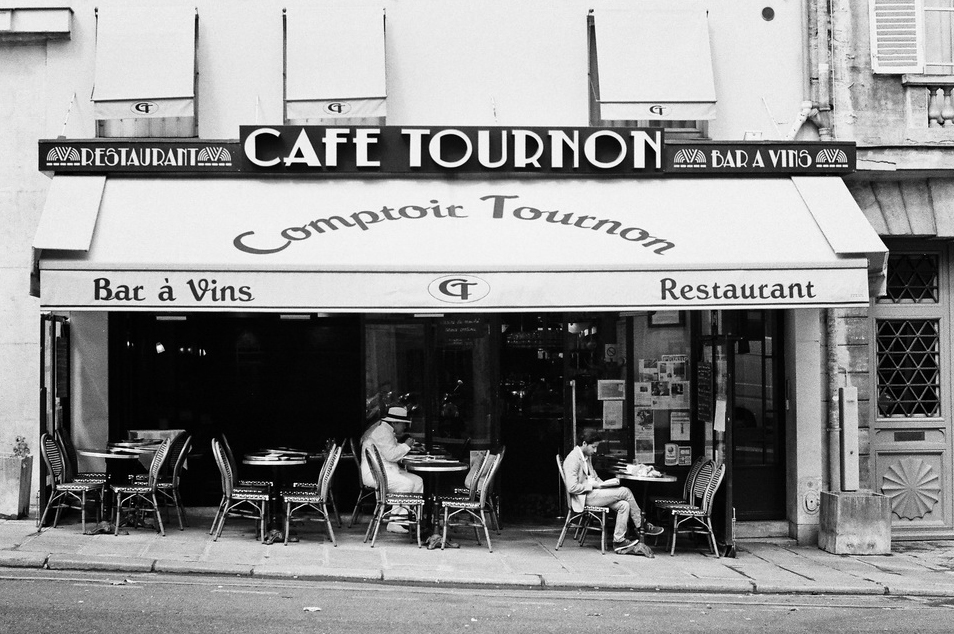
Over the half century since The Paris Review moved its headquarters to New York, we have often relied on a Paris editor to bring us the literary news from France. These Paris editors have included, at different times, Robert Silvers, Nelson Aldrich, Maxine Groffsky, and Susannah Hunnewell. Our new Paris editor, Antonin Baudry, served the French government as cultural counselor in New York and Madrid, as president of the Institut Français, and as an aide and speechwriter to foreign minister Dominique de Villepin during the Iraq crisis, an experience on which he based a best-selling graphic novel and hit movie (released here as Weapons of Mass Diplomacy and The French Minister, respectively). We heard from Antonin earlier this week. —L. S.
Dear Lorin,
I’m writing you from the Café de Tournon, where the founders of The Paris Reviewspent so much time back in the fifties. It happens to be my local, too. Today I ordered a café crème instead of my usual espresso. I’m celebrating your decision to make me the Paris editor of The Paris Review. I admit it sounds bizarre to me, though it’s hard to say what exactly counts as bizarre these days, around here. In any case, I will strive to do my duty by our readers … whatever that may turn out to be.
When you called to offer me the job, you asked me two questions I didn’t answer—I’ll try to do it now, instead, in the Café de Tournon. (Le temps d’un crème.) First, you asked why exactly Hemingway’s memoir A Moveable Feast has become a best-seller in Paris, in the wake of the recent attacks. Second, you asked how American readers should understand Michel Houellebecq’s recent op-ed in the New York Times—specifically, whether he’d really embraced the xenophobia of the National Front, or whether something else was going on.
The first question is easy to answer. What people buy when they buy A Moveable Feast is the title of the French edition—Paris est une fête. To be more precise, people buy the combination of this title and the name of the author. Hemingway is, rightly or wrongly, generally considered by French readers to be the Great American Novelist. We don’t even imagine how tricky and problematic this notion might be for Americans: from here it seems clear and distinct. What this book says to Parisians is something like, Paris is full of life and civilization; America acknowledges this in a profound, civilized, literary way; and thanks to that evidence we will absolutely survive whatever violence is to come.
It may sound a little easy, a little frivolous or self-centered, but I think it’s beautiful: it is a statement that is made through books, as if books and culture spoke for us more profoundly than political speeches. It is also a collective message from the people of one country toward the people of another country, from the French to the Americans—not the usual stuff, about our military alliance and “shared values,” that we hear every other day, especially when things go wrong between us, but really the people’s voice. It says something like, Thank you for appreciating us. We need it. Locally this sort of message is known as a mot d’amour. And it is not frequent, or easy, for a people to express collectively and directly un mot d’amour. That it is delivered by buying a book is no coincidence.
This idea—of direct expression—actually helps to answer your second question, too.
What Houellebecq advocates for, in his surprising op-ed, is direct democracy instead of representative democracy. This is a hazy, not to say fantastical, idea; even if it were feasible, it is unclear whether it would be an actual solution to our main problems or not. But that’s not the point. What Houellebecq expresses is a feeling—a strong, widespread distrust of our leaders.
In France we talk about a crise des élites, which is a polite way to say that our leaders are no longer considered relevant or representative or creative in their thinking. And Houellebecq, in his articles as well as in his novels, always likes to take the standpoint of the ordinary guy, lost in a society that has become hopelessly complex and hypocritical. He aims at speaking for what he considers or imagines as the silent majority of the country, what is sometimes called la France profonde—a concept that could be more myth than reality, as Sudhir Hazareesingh points out in his subtle, funny, and mischievous How the French Think: An Affectionate Portrait of an Intellectual People. Over the last fifteen years, many politicians have overused the image of la France profonde, or the France d’en bas, in an effort to distance themselves from intellectualism and culture and—less successfully—to bring right-wing voters back to the centrist parties.
But even if la France profonde is a myth, the fiction may bear some relation to real historical forces at work today. How can we explain the victory of the No vote in 2005, when the French rejected the new European constitution in a country-wide referendum, while the mainstream right and left and the media all encouraged the voters to vote Yes? Furthermore, how can we explain that this vote was ignored and the treaty signed a few years later by the government, with just some cosmetic changes in it? One could reach the conclusion that a large part of the French population is de facto not represented by the political system. That it could be a majority, and even a vast majority, is altogether possible. What Houellebecq does is explore this deep silent voice from inside; give it a brain, a body and a soul—someone’s idea of a literary embodiment of the unrepresented. It makes for a strange op-ed, and it gives us odd propositions, for example
that the French population has always maintained its trust in and solidarity with its police officers and its armed forces. That it has largely been repelled by the sermonizing airs of the so-called moral left (moral?) concerning how migrants and refugees are to be treated. That it has never viewed without suspicion the foreign military adventures its governments have seen fit to join.
You asked whether “trust in and solidarity with” the police and military should be read as a call for law and order, as against the protection of civil liberties, and whether the complaint about the “moral left” indicates support for the National Front. I can see how an American might read it that way—but the last sentence, about foreign military adventures, flies in the face of the French right wing. Those French who are hostile to refugees tend to believe (surprisingly) that the best way to keep them at bay is to bomb their countries. Houellebecq does not. In fact, he does not embrace any real political position. He embraces an anti-political one—the position of those who simply can’t stand politics and politicians, who don’t know what should be done but who know that things are going wrong, and always will.
One last thing, Lorin, before leaving the calm of the Café de Tournon—because the killings are still so much in the air, and because it would be a questionable omission not to mention how dense this air is. Leaving aside our ideas about Paris, or jihad and terrorism, it’s hard to stick to the facts and find out what these killings mean.
I guess the most undisputable fact is that these were the worst murders ever committed in Paris during peacetime. That is why I’ve been thinking these last few days about another American book set in Paris, Edgar Allan Poe’s 1841 novella The Murders in the Rue Morgue, which begins by imagining exactly that—the worst and most horrible murder ever committed in Paris. Poe’s genius detective, Dupin, notes that there is, in these murders, “something excessively outré—something altogether irreconcilable with our common notions of human action, even when we suppose the actors the most depraved of men.”
Because the murder is “so mysterious, so perplexing in all its particulars,” its solution requires intense intellectual activity—an intensity that could be compared, perhaps, with the incredible amount of geopolitical, psychological, sociological, theological, theatrical comments, tweets, editorials, and op-eds generated by the recent attacks. From the beginning, you wonder what Dupin is going to discover and, more important, how poor Poe will handle such a revelation. Poe’s own conclusion would not be an option for a writer today: in the end, Dupin finds out that the supposed murderer was actually an orangutan that escaped his owner and went postal. In Poe’s day, even the most depraved of human beings would not commit a murder that was soexcessively outré, at least not in a work of literature. That was the province of animals.
Today, who would think an animal—any animal among all the animals created by whoever created them all—could do anything worse than what we do? Why did we get that much worse? What went wrong with us?
Anyhow, it’s time to leave the Tournon, my friend. I hope you passed a happy Thanksgiving.
Warmly,
Antonin
Antonin
